

What 10.0.0.2 Actually Is
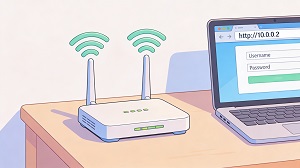 Think of 10.0.0.2 as the control panel address for many home and office routers on private networks. It is a private IPv4 address, which means it is only meant to be used inside your local network and cannot be reached directly from the public internet.
The address comes from the private range 10.0.0.0 – 10.255.255.255, a large block that manufacturers often use for routers and internal devices. When your router uses 10.0.0.2 as its default gateway, it becomes the “traffic director” that tells connected devices where to send data.
How to Open the 10.0.0.2 Admin Page
You do not need an active internet connection to open the router dashboard, but you must be connected to that router via Wi‑Fi or Ethernet.
Steps to log in:
- Connect your phone, laptop, or PC to the router (Wi‑Fi or cable).
- Open a browser such as Chrome, Edge, Firefox, or Safari.
- Type http://10.0.0.2 in the address bar and press Enter.
- When the login screen appears, enter the router username and password.
- Click Login or OK to access the admin panel.
If the page loads, you are now inside your router settings and can manage Wi‑Fi, security, and more.
Default Logins You Can Try
Many routers keep their factory credentials until you change them, which is why simple logins often work.
Common default username and password pairs:
| Username | Password |
|---|---|
| admin | admin |
| admin | password |
| admin | zoomadsl |
| zoomadsl | admin |
| admin | epicrouter |
| root | root |
| (blank) | admin |
If none of these work, either someone already changed the password or your router uses a different preset combination listed on its label or in the manual.
If 10.0.0.2 Is Not Your Router IP
Some routers use other gateway addresses like 10.0.0.1 or 192.168.1.1. You can quickly check what your current router IP is from your operating system.
On Windows:
- Press Windows + R, type cmd, and press Enter.
- In the command prompt, type ipconfig.
- Find the value next to Default Gateway – that is your router’s IP.
On macOS:
- Open System Settings.
- Go to Network and select your active connection.
- Click Details → TCP/IP.
- Look for the Router field – that is the address you need.
If you see 10.0.0.2 there, you are using the correct login address.
What You Can Change After Logging In
Once you are signed in, you get access to the main controls for your network.
Key areas you can manage:
- Network & Internet: adjust DNS servers, LAN and WAN settings, and fix IP conflicts.
- Wi‑Fi: rename your Wi‑Fi (SSID), change the wireless password, and switch between 2.4 GHz and 5 GHz bands.
- Security: change the admin login credentials, enable firewall options, and set up MAC address filtering for extra control.
- Advanced tools: configure parental controls, port forwarding for games and apps, guest networks, and bandwidth limits.
It is a good idea to immediately change the default admin password so no one else on your network can easily access the router settings.
Brands That Often Use 10.0.0.2
Several router manufacturers ship devices that use 10.0.0.2 as the default gateway address. Some examples include: Zoom, Gemtek, Bec Technologies, Jaht, EpicRouter.
You can usually find the exact model and sometimes the default login details on a sticker on the back or bottom of the router.
Fixing Common 10.0.0.2 Login Problems
If the page does not load or you cannot log in, a few common issues are usually to blame.
- Page does not open: Make sure you are connected to that router, turn off VPNs or proxy services, and try a different browser.
- Typing mistake: The address uses only zeros – not the letter “O” – and has only four blocks: 10.0.0.2, not 10.O.O.2 or 10.0.0.0.2.
- Wrong credentials: Check the router label or manual, try the typical defaults, and if necessary, reset the router to factory settings.
If you suspect the router uses another gateway, confirm it using the IP check steps above.
How to Factory Reset Your Router
If you are locked out and nothing else works, restoring factory settings will bring the router back to its original login details.
General reset steps:
- Find the small reset button (usually a pinhole on the back).
- Press and hold it for about 10–15 seconds with a paperclip or pin.
- Release the button and wait while the router restarts.
- After the reboot, the router uses its default settings again.
- Log in with the factory username and password.
Remember that this will erase any custom Wi‑Fi name, password, or advanced configuration you previously set.
Avoiding Common 10.0.0.2 Typos
Many login errors come from entering the wrong format in the browser. Here are a few examples you should avoid:
- 10.0.0.0.2 (extra zero)
- 1O.O.O.2 (letter “O” instead of zero)
- http://www.10.0.0.2 (the “www” is not needed)
Always type the address exactly as: http://10.0.0.2