

10.24.39.113 – What is this IP
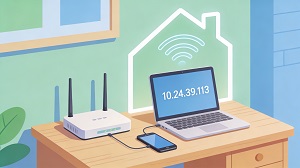 The IP address 10.24.39.113 is a private IPv4 address that lives inside local networks such as your home Wi‑Fi, office LAN, or a company network. You will not find it directly on the public internet because it is meant only for internal communication between devices on the same network.
If you are seeing this address on your phone, laptop, or router page, it simply means it has been assigned inside your own local network.
Public or private address?
The address 10.24.39.113 is part of the 10.0.0.0/8 private range defined by IANA in RFC 1918. That means anyone can use it inside their own network without registering it and it will never be routed across the public internet.
Within this setup, 10.24.39.113 usually belongs to the smaller subnet 10.24.39.0/24, which covers addresses from 10.24.39.0 to 10.24.39.255. In that subnet, 10.24.39.255 is the broadcast address and you can have up to 254 usable device IPs.
What is 10.24.39.113 used for?
In everyday use, 10.24.39.113 is just one of many possible local addresses that your router can hand out.
It can be assigned to common devices like desktops, laptops, phones, tablets, printers, NAS boxes, servers, or even wireless access points. The point is to let these devices talk to each other inside the same network without exposing them directly to the wider internet.
In some setups, a private IP in this range might also be used for router or gateway management. For example, network admins often use 10.24.39.1 or 10.24.39.254 as the default gateway, but 10.24.39.113 could also belong to a router or network appliance depending on the configuration.
If you are curious whether 10.24.39.113 is hosting a management page, you can try opening it in a browser as http://10.24.39.113 or https://10.24.39.113 and see if a login screen appears.
How DHCP and NAT fit in
Most home and office networks use DHCP (Dynamic Host Configuration Protocol) so you do not have to manually set IPs on each device. Your router will automatically pick an available private address, such as 10.24.39.113, and assign it to your device, which means it can change over time as devices connect and disconnect.
Private addresses like 10.24.39.113 cannot talk to the public internet directly, so your router uses Network Address Translation (NAT) to bridge the gap. When you open a website, your device sends traffic from 10.24.39.113 to the router, which replaces that private IP with your public IP, forwards the request, then maps the response back to 10.24.39.113.
Technical details at a glance
Here is a quick technical snapshot of 10.24.39.113:
- Address type: Private IPv4
- Network class: Class A
- CIDR block: 10.24.39.0/24
- Decimal (iplong): 169355121
- Hexadecimal: 0x0A182771
- Reverse DNS: 113.39.24.10.in-addr.arpa
These values are mainly useful for network tools and diagnostics but they all describe the same underlying address.
Private vs public IPs
It helps to separate what happens inside your network from what the outside world sees.
- Private IPs like 10.24.39.113 only exist inside local networks, can be reused by many different networks around the world, and are not reachable directly from the internet.
- Public IPs are assigned by your internet provider, must be globally unique, and are what websites actually see when you connect.
Your router usually has both: a private IP on the internal side and a public IP facing the internet. When you browse, servers only see your router’s public IP, not 10.24.39.113.
Most home connections get a dynamic public IP that can change periodically because IPv4 addresses are limited and ISPs recycle them. Static public IPs are more common for businesses and servers that need to be reachable at a fixed address, such as web or email servers.
Is 10.24.39.113 a security risk?
On its own, 10.24.39.113 is not a danger. It cannot be accessed directly from the internet and is hidden behind your router’s NAT. Only devices on your own local network can see or reach it.
The real security concern is who can join your Wi‑Fi or wired network. If someone gets into your network, they could potentially attempt to access devices at private addresses like 10.24.39.113. That is why strong Wi‑Fi passwords, up‑to‑date router firmware, and changing default admin credentials are all important.
When might you use this IP?
You might need to work with 10.24.39.113 when you are troubleshooting or configuring your network.
Typical situations include: checking which device has that IP during diagnostics, configuring a local server, setting up port forwarding, investigating IP conflicts, or opening a router or access point interface hosted at that address. More advanced users sometimes assign fixed private IPs to devices such as CCTV cameras, smart home hubs, business servers, or VoIP phones so they are easier to manage.
In short, 10.24.39.113 is a normal private IPv4 address that helps devices communicate inside your network and relies on your router to reach the internet. If you see it on one of your devices, it just confirms you are connected to a private 10.x.x.x network, which is one of the most widely used private ranges worldwide.
Is 10.24.1.39.113 a Real IP? Understanding This Common Mistake
When you run into an address like 10.24.1.39.113 while troubleshooting a network issue, the first step is to verify whether it is actually a valid IPv4 address or just a typo. A standard IPv4 address always has four octets, so if you see five numbered blocks separated by dots, your tools will not be able to ping it, assign it to a device, or use it in routing rules. Start by checking the original source – a router screenshot, a configuration guide, or a log file – and confirm which correct private IP in the 10.x.x.x range was intended. Once you have a valid address, you can test connectivity with a simple ping from your computer or command line to see if the target device responds.
If the ping fails, log into your router’s admin panel and make sure the device is actually connected to the local network, has an assigned IP, and is not blocked by firewall rules. You can also run an IP lookup or local scanning tool to list all live devices on your LAN and verify that the corrected address appears there. When you combine basic syntax checks, pings, router status pages, and IP lookup tools, you quickly identify whether “10.24.1.39.113” was just mistyped or points to a device that is offline or misconfigured. This approach helps home users and admins solve “what is this IP” questions without guesswork and keeps your network documentation clean and accurate.