

Flipper One: A Pocket Linux Powerhouse for Tinkerers
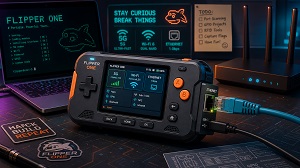 Flipper’s new handheld, the Flipper One, is a multi‑tool computer designed for tinkerers and tech enthusiasts. It doesn’t replace the much‑loved Flipper Zero, but sits alongside it as a more powerful, better‑connected option.
Positioning vs Flipper Zero
In 2020, the Flipper Zero became a hit with hackers, hobbyists, and curious beginners who wanted to experiment with the tech already in their homes. Now the company is back with the Flipper One, the second‑generation device aimed at the same crowd but with far more serious hardware. The new model keeps the familiar Flipper design and “Swiss Army knife” philosophy, but adds modern connectivity and computing power to help newcomers and experts alike explore, test, and tinker.
PCMag’s Justyn Newman previously spent a lot of time with the Flipper Zero and showed how flexible it could be: he used it to read a pet’s microchip via RFID, turn it into a PC resource monitor, and even set it up as an extra remote for devices around his house. The Flipper One builds on this spirit of experimentation, but shifts the focus from simple radio tricks and access control to full‑blown networking and high‑performance computing.
Where the Zero was mainly built for offline, point‑to‑point access‑control protocols, the Flipper One is all about modern connectivity: 5G, Ethernet, satellite links, and Wi‑Fi. It comes with two WAN/LAN Ethernet ports at 1Gbps, USB Ethernet support up to 5Gbps, and Wi‑Fi 6E, with optional modules adding 5G support. In other words, it’s designed to act as a compact lab for network testing, data transfer, and connected experiments.
Flipper CEO Pavel Zhovner describes it as a tool focused on “networking, data transfer, and high‑performance computing,” powered by strong hardware and an open Linux toolkit, with enough muscle for software‑defined radio (SDR) and running local AI. Under the hood, the Flipper One uses an 8‑core RK3576 system‑on‑chip, a Mali‑G52 GPU, and an NPU for running LLMs and other AI models locally, paired with 8GB of RAM and a Linux operating system on the main CPU. A separate low‑power microcontroller based on the Raspberry Pi RP2350 handles the display, touchpad, LEDs, and other interface tasks, letting the device stay responsive while the main system tackles heavier workloads.
Open Development and Community Input
Beyond the hardware, Flipper is also changing how it develops the One. The company plans to open up its development process by publishing internal conversations, task trackers, and debates – the kind of “messy stuff” most companies hide. This will live on a public Flipper One Developer Portal, where anyone can follow progress and suggest new ideas, keeping the project as open and community‑driven as possible.
Release Timing and Price
There’s no release date yet, and Flipper has hinted that it could be some time before the One actually ships. Pricing also remains unknown, though it’s expected to come in above the Flipper Zero’s 199‑dollar price, given the more advanced components and features. Zhovner acknowledges that the project faces plenty of uncertainty, from technical hurdles to financial risks like the current RAM chip shortage, but says the team is committed to pushing ahead and doing as much as they can with the ambitious design.